Publish Date
March 2026
How to Buy Your First Expensive Whisky

Tyler Berry
Whisky Collector
There's a moment in every collector's journey where you start looking at a bottle and thinking "that's a lot of money." And then, a few months later, you find yourself looking at the same price and thinking "but it might be worth it."
If you're considering your first purchase over £100, £500, or £1,000, you're not just buying whisky anymore. You're making a decision about what your collection means to you. Here's what's worth thinking about before you commit.
Know why you're buying it
This sounds simple but it matters more than anything else. There are three reasons people buy expensive whisky, and they lead to very different decisions.
To drink it. You've tasted something extraordinary and you want a bottle of your own. You want to share it with people who'll appreciate it. You want to experience it slowly, over months, one dram at a time. This is the purest reason to buy any whisky, and if this is why you're buying, the only question is whether the liquid is worth the price to you. Nobody else's opinion matters.
To collect it. You want the bottle on your shelf. The distillery, the age, the story, the packaging. It completes a set or represents something meaningful to you. You might open it one day. You might not. Either way, owning it brings you something. This is valid. Collections are about more than consumption.
To invest. You believe the bottle will appreciate in value and you might sell it in the future. This is a fundamentally different activity from collecting or drinking, and it requires a different mindset. We'll come back to this.
Being honest about your motivation helps you avoid the most common regret: buying an investment bottle when you really wanted a drinking bottle, or opening something you should have kept sealed.
Do your research on price
Expensive whisky has a wide price range for the same bottle. A limited release might be £180 at one retailer and £240 at another. At auction, the same bottle could be £150 or £300 depending on the day.
Before you buy, check prices across multiple sources. Specialist retailers, auction houses, and secondary market platforms all have different pricing dynamics. A few minutes of comparison can save you a significant amount.
This is especially true for allocated or limited releases where retailers sometimes mark up well beyond the recommended retail price. Knowing the RRP and what others are charging gives you a baseline to judge whether a price is fair.
Understand what makes whisky expensive
Not all expensive whisky is expensive for the same reason, and understanding the driver helps you make a better decision.
Age. Older whisky costs more because it's been sitting in a cask for decades, tying up capital and warehouse space. A 30-year-old single malt has had 30 years of evaporation (the angel's share), meaning fewer bottles from the original cask. The scarcity is real. Whether a 30-year-old is twice as good as a 15-year-old is a different question entirely.
Rarity. Limited releases, single cask bottlings, and closed distillery stock command premiums because there's a fixed supply and growing demand. A bottle from a distillery that no longer exists can only become rarer over time.
Reputation. Some distilleries and bottlings carry a name premium. Macallan, Dalmore, and certain Japanese distilleries command prices that reflect brand prestige as much as liquid quality. This isn't necessarily a bad thing, but it's worth being aware that you're partly paying for the label.
Packaging. Crystal decanters, hand-numbered bottles, bespoke wooden boxes. These add cost. They don't add flavour. If you're buying to drink, ask yourself how much of the price is the liquid and how much is the presentation.

The "should I drink it?" question
This is the question every collector wrestles with. You've spent £500 on a bottle. It's sitting on your shelf. Every time you look at it you think about opening it. But you also think about what it might be worth in five years.
Here's a useful framework. If the bottle is replaceable at a similar price, drink it when the moment feels right. If it's genuinely irreplaceable and appreciating in value, the decision is harder and more personal.
Some collectors buy two: one to drink, one to keep. That's a luxury most of us can't afford, but if you can, it neatly solves the dilemma.
The one thing to avoid is letting a bottle sit untouched for years out of indecision. If you're never going to open it, be honest about that and treat it as a collectible. If you are going to open it, stop waiting for the "perfect occasion." A Tuesday evening when you feel like it is a perfect occasion.
Whisky as investment
A word of caution. Whisky has generated impressive returns for some collectors over the past decade. Certain bottles have doubled or tripled in value. But past performance is not a guarantee, and whisky investment has risks that aren't always obvious.
Storage matters. Whisky needs to be stored upright, away from light, at a stable temperature. A bottle with a degraded cork or sun-faded label loses value fast.
Provenance matters. Buyers on the secondary market care about where the bottle has been. An unboxed bottle with a missing tube is worth less than a complete, pristine set. If you're buying with resale in mind, keep everything.
Liquidity matters. Whisky isn't like stocks. You can't sell at the tap of a button. Auctions take time, charge commission (often 15-25% for the seller), and there's no guarantee your bottle will reach the price you want.
If you enjoy whisky and happen to own bottles that appreciate, that's a wonderful bonus. If you're buying whisky purely as a financial instrument, you should understand exactly what you're getting into.
Track what you own
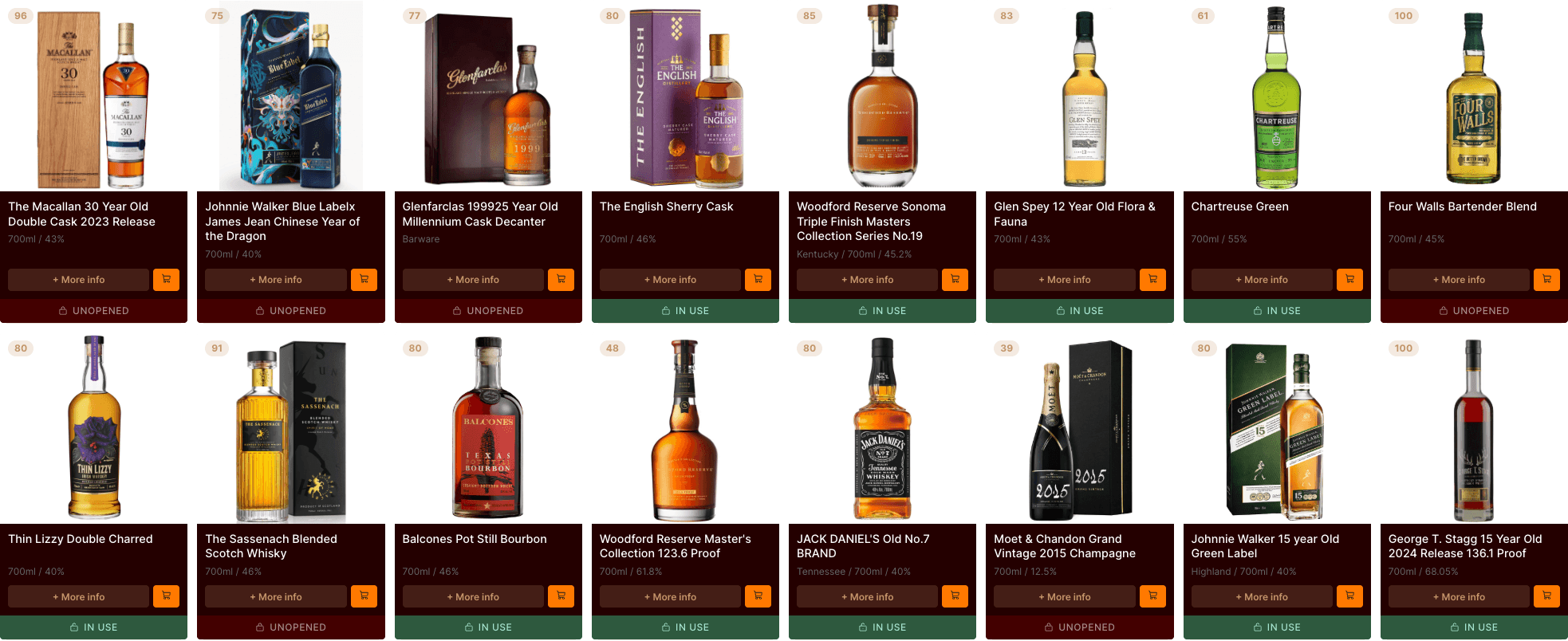
Once you start spending serious money on whisky, tracking your collection becomes essential rather than optional. You need to know what you own, what you paid, and what it's worth now. For insurance purposes, for your own records, and for the peace of mind that comes from knowing everything is documented.
A digital collection tracker handles this automatically. Every bottle with its purchase price, date, and current estimated value. A running total of your collection's worth. And when your insurer asks for documentation, you can generate a report instead of digging through old emails.
Cabinet can help
Cabinet tracks your collection value automatically. Every bottle you add with a purchase price contributes to a running total, and you can see how your collection's value changes over time. The price comparison feature helps you find the best deal before you buy, and the insurance export generates a PDF report your insurer can actually use.
Whether your next bottle costs £50 or £5,000, Cabinet makes sure you've got a clear record of it.
Start tracking your collection value. It's free.